
Floating vs Fixed Docks: Which Design Fits Changing Water Levels?
A sound waterfront decision connects function, exposure, foundations, access, and future use. This article compares floating docks, and fixed docks through water-level variation, guide piles, anchoring, permanent supports, and vessel access. The purpose is to show what changes when the site, load, water behavior, foundation, material, and intended use are held constant. That approach avoids a misleading best-option ranking and keeps the analysis connected to an actual waterfront project.
The service page provides the confirmed project scope and material categories used for this comparison. Property owners can dock and boat slip construction before using the sections below to organize questions for a site review and estimate.
The comparison between floating docks, and fixed docks should be made through water-level variation, guide piles, anchoring, permanent supports, and vessel access. That keeps the discussion tied to the actual project instead of reducing it to a preference for one material or familiar name. The official service information repeatedly connects selection to water conditions, soil or bottom conditions, structural load, drainage, and access. Those variables can change the correct answer even when two properties appear similar in photographs.
What each option is intended to do
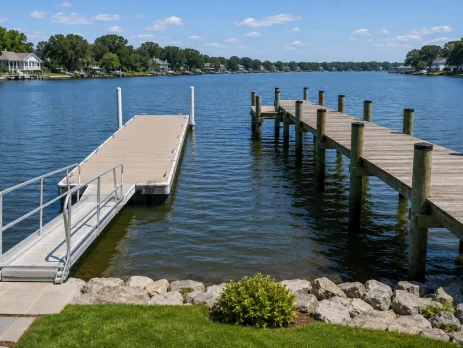
When floating docks are evaluated, the visible material is only one part of the decision. Platforms that rise and fall with the water level. Positioned for lakes and other water bodies with seasonal or significant level changes. Use floats, guide piles, attachment systems, and anchoring to control movement. Must be matched to vessel size, waves, current, access, and the range of water elevation. In Floating vs Fixed Docks: Which Design Fits Changing Water Levels?, this option is assessed through water-level variation, guide piles, anchoring, permanent supports, and vessel access.
Fixed Docks should be read as a complete construction system, not as a label for the visible surface. Pile-supported platforms that remain at a set elevation. Positioned for rivers and coastal zones where water levels are comparatively stable. Use permanent supports with wood or composite decking and can serve long-term mooring needs. Depend on pile depth, water depth, bottom conditions, waves, current, and vessel requirements. In Floating vs Fixed Docks: Which Design Fits Changing Water Levels?, this option is assessed through water-level variation, guide piles, anchoring, permanent supports, and vessel access.
The available service data shows why a universal answer would be misleading. Floating docks rise and fall with water levels, while fixed docks are built on piles for locations with more stable levels. The page lists aluminum frames, composite decking, polystyrene floats, wood structures, guide piles, anchoring systems, and boat lifts. Project selection considers vessel size, water-level variation, water depth, current or wave conditions, material choice, and site access. In Floating vs Fixed Docks: Which Design Fits Changing Water Levels?, these points are used specifically to compare floating docks, and fixed docks through water-level variation, guide piles, anchoring, permanent supports, and vessel access.
Water level, waves, and ground conditions
When floating docks and fixed docks are placed on the same property, the site becomes the deciding evidence. Positioned for lakes and other water bodies with seasonal or significant level changes. Positioned for rivers and coastal zones where water levels are comparatively stable. The difference does not make one option better in every setting; it shows that the same property goal must be translated into the correct response to water, soil, bottom, slope, or access. Dock construction starts at $35 per square foot, dock repair at $25 per square foot, and accessory sets at $500, with labor and materials included in the listed starting figures. This site-level review is applied here to water-level variation, guide piles, anchoring, permanent supports, and vessel access.
- Water-level behavior – Note whether the water level is comparatively stable or moves seasonally or tidally. Fixed and floating access systems respond differently, and shoreline walls may face changing pressure or erosion patterns. For Floating vs Fixed Docks: Which Design Fits Changing Water Levels?, use this checkpoint to compare floating docks, and fixed docks through water-level variation, guide piles, anchoring, permanent supports, and vessel access.
- Structural load – List the people, boats, equipment, soil, wave, or traffic loads the project must carry. A private residential use and a marina or commercial setting should not be compared as though they demand the same structure. For Floating vs Fixed Docks: Which Design Fits Changing Water Levels?, use this checkpoint to compare floating docks, and fixed docks through water-level variation, guide piles, anchoring, permanent supports, and vessel access.
- Material objective – State whether the priority is a lower listed starting cost, natural appearance, reduced routine upkeep, corrosion resistance, flexibility, drainage, or maximum structural strength. No single material leads every category. For Floating vs Fixed Docks: Which Design Fits Changing Water Levels?, use this checkpoint to compare floating docks, and fixed docks through water-level variation, guide piles, anchoring, permanent supports, and vessel access.
- Maintenance plan – Decide what inspection and upkeep the owner is prepared to perform. Low-maintenance surfaces do not eliminate the need to inspect foundations, connections, anchors, drainage, piles, or framing. For Floating vs Fixed Docks: Which Design Fits Changing Water Levels?, use this checkpoint to compare floating docks, and fixed docks through water-level variation, guide piles, anchoring, permanent supports, and vessel access.
- Repairability – Separate isolated defects from system-wide failure. Repair can preserve serviceable components, while replacement becomes a different scope when supports, alignment, drainage, or overall capacity are no longer reliable. For Floating vs Fixed Docks: Which Design Fits Changing Water Levels?, use this checkpoint to compare floating docks, and fixed docks through water-level variation, guide piles, anchoring, permanent supports, and vessel access.
- Construction access – Document gates, slopes, narrow side yards, existing docks, landscaping, overhead restrictions, and whether equipment must work from shore or water. Access can change methods and mobilization. For Floating vs Fixed Docks: Which Design Fits Changing Water Levels?, use this checkpoint to compare floating docks, and fixed docks through water-level variation, guide piles, anchoring, permanent supports, and vessel access.
Comparing construction systems rather than surfaces
The visible material should be evaluated together with the structure behind or beneath it. For floating docks, use floats, guide piles, attachment systems, and anchoring to control movement. For fixed docks, use permanent supports with wood or composite decking and can serve long-term mooring needs. Foundations, piles, anchors, frames, reinforcement, drainage, and connections are not optional details; they are the parts that transfer load and keep the selected material in the position where it can work. A proposal that names only the surface material is therefore incomplete.
The intended use of the property changes the comparison. Private access, frequent public traffic, a small boat, a large vessel, commercial equipment, or a high retained slope impose different loads and dimensions. Floating Docks and fixed docks should therefore be compared against the same use case. The service pages distinguish residential work from marinas and other commercial projects, which is a reminder that size and load cannot be separated from material and foundation choices.
Maintenance and repair implications
Cost comparison should use the same scope and the same site assumptions. The official page provides starting figures or service categories, but those references do not replace a project estimate. Length or area, material, foundations, removal, repair, access, water depth, soil or bottom conditions, drainage, anchors, piles, and accessories can change the amount of work. The useful question is not simply whether floating docks appear cheaper than fixed docks; it is whether both proposals include everything required to perform the same job at the same property.
Maintenance has to be divided into surface care and structural inspection. A material described as low-maintenance can reduce routine work on the visible surface, but the owner still needs to watch the support system, connections, drainage, anchors, piles, frames, settlement, and shoreline transitions. Must be matched to vessel size, waves, current, access, and the range of water elevation. Depend on pile depth, water depth, bottom conditions, waves, current, and vessel requirements. The correct comparison considers what can be inspected and repaired over time, not only what looks finished on completion day.
The official page supplies several concrete reference points. A dock can be floating or fixed and is used for boat mooring and storage. Floating docks rise and fall with water levels, while fixed docks are built on piles for locations with more stable levels. The page lists aluminum frames, composite decking, polystyrene floats, wood structures, guide piles, anchoring systems, and boat lifts. In Floating vs Fixed Docks: Which Design Fits Changing Water Levels?, these points are used specifically to compare floating docks, and fixed docks through water-level variation, guide piles, anchoring, permanent supports, and vessel access.
How to prepare a useful project brief
- State the required result – Describe the completed outcome in practical terms, such as stable shoreline soil, controlled wave impact, reliable mooring, safe pedestrian access, or dependable structural support. Apply it here to floating docks, and fixed docks, with emphasis on water-level variation, guide piles, anchoring, permanent supports, and vessel access.
- Map exposure and level changes – Record whether the site is open, sheltered, tidal, seasonal, saltwater, brackish, riverine, or lakefront and how the water level changes. Apply it here to floating docks, and fixed docks, with emphasis on water-level variation, guide piles, anchoring, permanent supports, and vessel access.
- Check existing supports and drainage – Look beyond surfaces to piles, anchors, frames, foundations, soil loss, groundwater paths, and drainage outlets. Apply it here to floating docks, and fixed docks, with emphasis on water-level variation, guide piles, anchoring, permanent supports, and vessel access.
- Compare material and structural systems – Judge each alternative as a full assembly. Material benefits matter only when the support system and site conditions are also suitable. Apply it here to floating docks, and fixed docks, with emphasis on water-level variation, guide piles, anchoring, permanent supports, and vessel access.
- Base the decision on the assessed site – Use the site review to choose the option and define the scope rather than relying on a universal best-material claim. Apply it here to floating docks, and fixed docks, with emphasis on water-level variation, guide piles, anchoring, permanent supports, and vessel access.
Site conditions create the clearest separation between floating docks and fixed docks. Positioned for lakes and other water bodies with seasonal or significant level changes. Positioned for rivers and coastal zones where water levels are comparatively stable. The difference does not make one option better in every setting; it shows that the same property goal must be translated into the correct response to water, soil, bottom, slope, or access. Dock construction starts at $35 per square foot, dock repair at $25 per square foot, and accessory sets at $500, with labor and materials included in the listed starting figures. This site-level review is applied here to water-level variation, guide piles, anchoring, permanent supports, and vessel access.
Turning the comparison into a buildable plan
The comparison between floating docks, and fixed docks becomes useful when it produces a clear site brief. The owner should be able to state the required function, describe the water and ground conditions, identify access limits, and explain future use. That information allows a contractor to define a buildable system instead of forcing a generic material preference onto the property.
For Floating vs Fixed Docks: Which Design Fits Changing Water Levels?, the next practical step is to provide the property location, photographs, approximate dimensions, and a description of the required result. Those details support a preliminary review focused on water-level variation, guide piles, anchoring, permanent supports, and vessel access and help identify what must be verified during the site assessment before construction, repair, or replacement is defined.