
Search Results - Paul's missionary journey

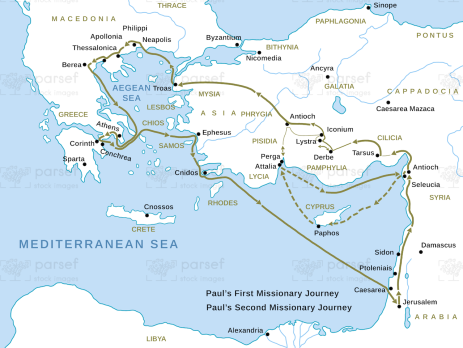
Acts First and Second Journeys of Paul

The map displays the routes of Paul's first and second missionary journeys as recorded in the biblical book of Acts. The map shows the cities and towns visited by Paul and his companions, including Antioch, Iconium, Lystra, Derbe, Philippi, Thessalonica, Athens, Corinth, and Ephesus. The map also indicates the major sea routes traveled by Paul, including the Mediterranean Sea and the Aegean Sea. The map provides a visual representation of the vast distances covered by Paul during his missionary work and helps viewers to better understand the context of the stories recorded in the book of Acts. One Year License. For personal, church or classroom use only.
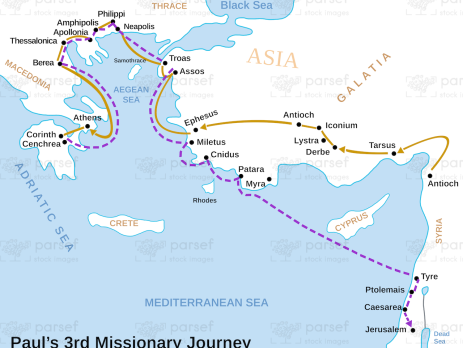
Acts Pauls Third Missionary Journey

The map depicts the Third Missionary Journey of the apostle Paul, as described in the biblical book of Acts. The journey took place in the years 53-57 AD and covered a large portion of the eastern Mediterranean region. The map shows the major cities and regions visited by Paul during this journey, including Ephesus, Troas, Philippi, Athens, Corinth, and Jerusalem. The journey was marked by many significant events, such as the riot in Ephesus, Paul's preaching in the Areopagus in Athens, and his final journey to Jerusalem, where he was arrested and ultimately sent to Rome for trial. The map also shows the extensive sea voyages undertaken by Paul and his companions, as they traveled across the Aegean and Mediterranean seas. One Year License. For personal, church or classroom use only.

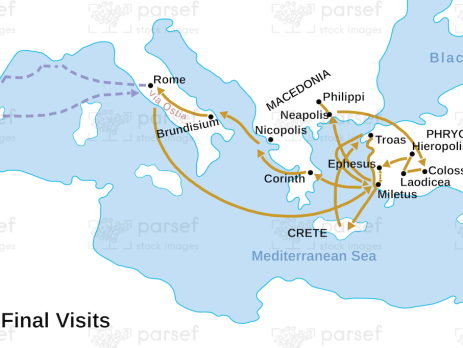
Paul’s Final Visits

The stock image depicts the journey of the Apostle Paul during his final mission trip to various locations in the eastern Mediterranean. The map highlights the major cities he visited, including Jerusalem, Caesarea, Ephesus, Troas, Philippi, Thessalonica, Corinth, and Rome. It shows the routes he took and the distances he traveled, as well as the geographical features of the regions he passed through. The map also indicates the locations where Paul wrote his letters to the churches, such as his Epistles to the Ephesians, Philippians, and Colossians. It includes historical and cultural information about the places he visited, such as their significance in the Roman Empire and their religious traditions. The image shows Paul's final journey from Jerusalem to Rome, including his shipwreck on the island of Malta, where he was welcomed by the locals and continued to preach the gospel. The map also illustrates his final imprisonment in Rome and his...

The City of Antioch: Mapping the Launchpad of Paul’s Missions

The ancient city of Antioch in Syria (modern-day Antakya, Turkey) was one of the most important cities in the Roman Empire and played a significant role in the spread of Christianity. Known as the "launchpad" for the Apostle Paul's missionary journeys, Antioch holds a unique place in Christian history as the first community to officially welcome Gentiles and as the birthplace of the term "Christian." This article explores Antioch’s role in Paul’s missions, its religious and cultural context, and its legacy in the early church. 1. The Founding and Historical Context of Antioch 1.1 Origins of Antioch Founded around 300 BCE by Seleucus I Nicator, one of Alexander the Great's generals, Antioch quickly grew to become one of the largest cities in the ancient world. Named after Seleucus's father, Antiochus, the city flourished as a center of trade, culture, and politics. Its strategic location along the Orontes River and proximity to the Mediterranean...

Mapping the Road to Damascus: Paul’s Conversion Experience

The journey to Damascus marks one of the most transformative moments in the history of early Christianity, leading to the conversion of Saul of Tarsus, who would become the Apostle Paul. This article explores the historical, geographical, and theological dimensions of Paul's conversion, highlighting its significance in shaping Christian thought and mission. 1. Historical Context: The Early Church and Persecution 1.1 The Rise of Christianity The early Christian movement began in Jerusalem after the resurrection of Jesus Christ, spreading rapidly throughout Judea and beyond. As the number of followers increased, so did opposition from both Jewish leaders and Roman authorities. The apostles, particularly Peter and John, preached boldly about the resurrection, leading to significant growth but also persecution. 1.2 Saul of Tarsus: A Zealous Persecutor Saul, a Pharisee from Tarsus, emerged as a key figure in the persecution of Christians. He was educated under Gamaliel, a respected teacher of the law, and held a deep...

Ephesus: Mapping Paul’s Ministry in a City of Idols

The Historical Significance of Ephesus Ephesus, one of the most influential cities of the ancient world, holds a unique place in the history of early Christianity. Nestled along the western coast of what is now Turkey, this thriving metropolis was a center of commerce, culture, and religion. It was here that the Apostle Paul engaged in a transformative ministry, addressing the challenges of idolatry and shaping the early Christian community. This article explores the historical, cultural, and archaeological aspects of Ephesus, mapping Paul’s ministry in a city dominated by idols. 1. Geographic and Historical Context Location and Topography Ephesus is situated near the Aegean Sea, at the mouth of the Cayster River, providing it with a strategic location for trade and transportation. Natural Harbor: The city's proximity to the sea facilitated its role as a bustling port, contributing to its wealth and cosmopolitan character. Trade Routes: Ephesus was connected by important trade routes, linking...

The Cities of Paul’s Letters: Mapping the Early Christian Communities

The Apostle Paul is one of the most influential figures in the early Christian church, and his letters (epistles) form a substantial part of the New Testament. Written to various communities across the Roman Empire, these letters provide insights into the theological discussions, ethical teachings, and struggles faced by early Christians. By mapping the cities addressed in Paul's letters, we can better understand the geographical, cultural, and historical contexts that shaped the early Christian communities. 1. Overview of Paul’s Ministry and Letters 1.1 The Life of Paul Background: Born as Saul of Tarsus, Paul was a Pharisee who initially persecuted Christians before experiencing a dramatic conversion on the road to Damascus (Acts 9:1-19). Following his conversion, he dedicated his life to spreading the Gospel. Missionary Journeys: Paul undertook three major missionary journeys throughout the Roman Empire, establishing churches and nurturing early Christian communities. 1.2 Structure of Paul’s Letters Types of Letters: Paul wrote...

Mapping the City of Corinth: Paul’s Letters and Ancient Greece

The Historical Significance of Corinth Corinth, a city steeped in history and cultural significance, stands as a key site in the early development of Christianity. Strategically located on the Isthmus of Corinth, this ancient city served as a vital link between the Peloponnese and mainland Greece, making it an economic and cultural hub in the ancient world. The Apostle Paul’s letters to the Corinthian church provide invaluable insights into the challenges and triumphs of early Christians. This article will explore the city of Corinth—its geography, history, significance in Paul’s ministry, and the implications of his letters on the early Christian community. Geographical Context of Corinth Location and Topography Strategic Position: Corinth was situated on the Isthmus of Corinth, connecting the Peloponnese to mainland Greece. This strategic location made it a crucial trade center and a bustling urban hub. Natural Features: The city was surrounded by mountain ranges, including Mount Geraneia to the northwest...

The Great Sea: Mapping the Mediterranean in Biblical Times

The Great Sea in Context The Mediterranean Sea, referred to as "The Great Sea" in the Bible, has played a pivotal role in shaping the history, culture, and economy of the ancient world. Stretching approximately 2,500 miles and bordered by three continents—Europe, Asia, and Africa—the Mediterranean has been a vital waterway for trade, travel, and cultural exchange since antiquity. This article delves into the significance of the Mediterranean Sea during biblical times, mapping its geographical features, exploring its impact on biblical narratives, and examining its role in the daily lives of ancient peoples. 1. Geographical Overview of the Mediterranean Sea 1.1 Physical Characteristics Size and Depth: The Mediterranean Sea covers an area of about 970,000 square miles, with depths reaching up to 18,000 feet in the Calypso Deep, located south of Greece. Its vastness and varied depth contributed to its importance as a trade route and a site for naval power. Coastal Regions:...